
ETOSHA TRAVEL TIPS
Etosha Waterholes: A Practical Guide to Better Wildlife Viewing
Etosha’s waterholes are observation points, not wildlife vending machines. Their value comes from understanding season, habitat, approach routes, animal behaviour and the patience to let a scene change.
Water availability, road access and animal concentrations change. Use this guide for strategy, then confirm current conditions with park or accommodation staff.
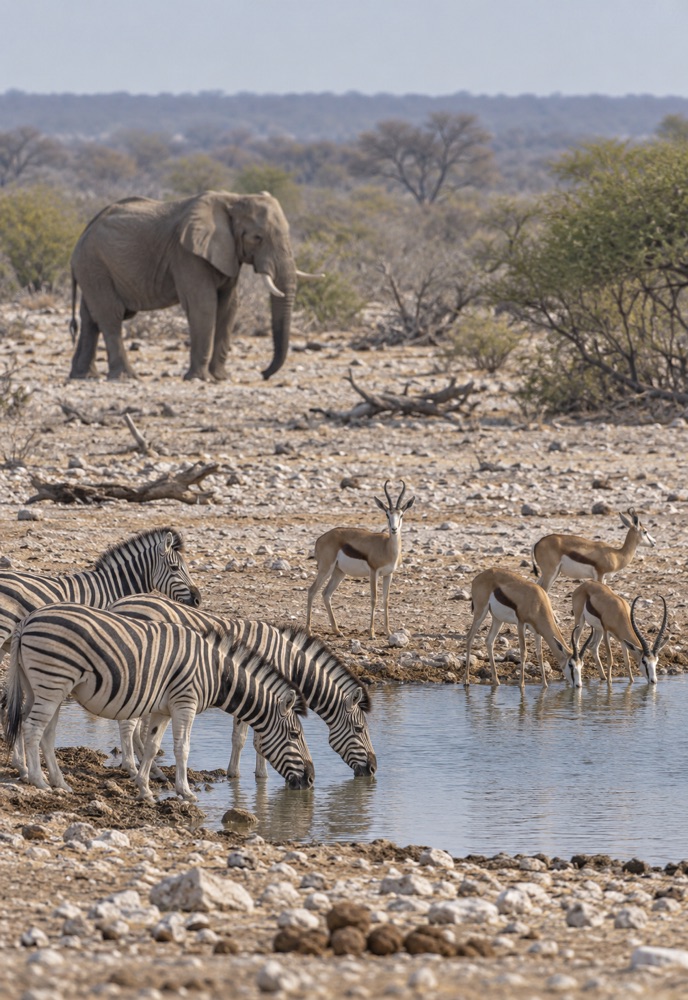
WHY WATERHOLES MATTER
Water changes wildlife distribution, especially as the landscape dries
Permanent and artificial sources can become increasingly important when seasonal water disappears. After rain, temporary water allows animals to spread more widely.
SCARCITY
Dry conditions concentrate opportunity
Dependable water may draw repeated movement, but the timing and species mix remain unpredictable.
ABUNDANCE
Rain disperses animals
Fresh grazing and temporary water reduce dependence on famous stops, making habitat scanning more important.
ROUTES
Approach paths are part of the sighting
Animals may be visible before they reach the water. Watch tracks, shade and the surrounding plain.
BEHAVIOUR
Drinking creates interaction
Vigilance, hierarchy, competition and waiting can be more revealing than the moment an animal lowers its head.
A BETTER WATERHOLE ROUTINE
Arrive quietly, scan widely and wait with purpose
A successful stop begins before the vehicle reaches the viewing position and ends before congestion or pressure damages the experience.
APPROACH
Reduce speed early
Animals may stand beside the road or behind other vehicles. Avoid abrupt arrival and dust.
SCAN
Check the full landscape
Search shade, approaches, open ground, trees and the direction alert animals are watching.
LISTEN
Use calls and silence as information
Alarm calls, bird activity and sudden stillness may reveal more than the water itself.
WAIT
Set a patient observation window
An empty-looking waterhole can change quickly. Give it time when tracks or animal behaviour suggest activity.
POSITION
Keep the road and animal routes open
Park without forming a barrier. A poor position is not permission to force into a gap.
LEAVE
Move on when the scene or traffic says so
If activity has settled or vehicles are adding pressure, a different habitat may be the better choice.
SEASONAL WATERHOLE STRATEGY
Use the season to refine expectations—not to promise sightings
The same waterhole can be busy, quiet, full, shallow or dry at different times. Rainfall, maintenance, disturbance and nearby grazing all matter.
EARLY DRY
Look for a landscape beginning to contract
Waterhole use may increase gradually while some seasonal resources remain available.
COOL DRY
Expect cold starts and open sight lines
Animal movement can be easier to read, but visitors should prepare for very cold early drives.
LATE DRY
Plan for heat, dust and strong water dependence
Busy waterholes may produce excellent observation alongside crowding and animal stress.
FIRST RAINS
Follow fresh growth and changing movement
A storm can reduce activity at a previously dependable stop by creating water elsewhere.
GREEN SEASON
Scan habitat beyond named water
Birding, young animals and landscape photography may be stronger priorities than concentration.
TRANSITION
Use local reports carefully
Recent conditions are more useful than a general seasonal label, but wildlife can change between one day and the next.
SELECTED WATERHOLES & VIEWING AREAS
Use names as orientation points, never as species guarantees
These well-known stops cover different regions and habitats. Road access, water and wildlife should always be confirmed against current information.
OKAUKUEJO
A camp-based viewing landmark
The floodlit setting can extend observation beyond a self-drive day when current camp access and facilities allow.
MORINGA
Central camp viewing at Halali
The setting can reward quiet evening observation without adding another long road loop.
KLEIN NAMUTONI & CHUDOB
Useful eastern-area options
Combine nearby water and woodland habitat rather than treating either stop as a single-species destination.
KALKHEUWEL
Mopane-country observation
The habitat and approach deserve as much attention as the water. Arrive slowly and scan the surrounding vegetation.
RIETFONTEIN
A broad, well-known stop
Its open setting can support longer scanning and bird observation, but current activity remains variable.
OKERFONTEIN & SALVADORA
Pan-edge context
These stops can combine long views with movement along the edge of open country.
OLIFANTSBAD & AUS
Western-route variety
Use them as part of a comfortable loop rather than stretching the day to chase a report.
OKONDEKA
Open northern pan-edge character
The sense of space can be rewarding even when animals are distant; binoculars are especially useful.
TWO PALMS & FISCHER’S PAN
Eastern scenery and birding potential
Seasonal conditions strongly influence the experience, making current road and water information important.
TSUMCOR & KLEIN OKEVI
Further eastern options
Build them into a regional plan with a safe return margin instead of adding them impulsively.
READ THE ANIMALS ALREADY THERE
Behaviour can reveal what is approaching or hidden
Waterhole viewing improves when attention shifts from a species wish list to posture, direction, sound and group movement.
VIGILANCE
Notice fixed attention
Several animals staring in one direction may be responding to a predator, vehicle or unfamiliar movement.
SPACE
Watch animals make room
A sudden gap can indicate the approach of a dominant individual or larger species.
ALARM
Listen before searching randomly
Calls and abrupt flight help narrow the direction that deserves closer scanning.
HESITATION
Treat refusal to drink as information
Animals may detect danger, disturbance or a blocked approach that visitors cannot yet see.
BIRDS
Use aerial activity
Raptors, vultures, waterbirds and sudden flock movement broaden the story beyond mammals.
DEPARTURE
Follow direction without pursuing
Where animals leave can reveal routes and habitat, but do not chase them away from the water.
WATERHOLE ETHICS & VEHICLE POSITIONING
A good sighting leaves animals able to use the water naturally
Water is a critical resource, particularly in dry conditions. Visitor behaviour should never make access more difficult.
APPROACH LANE
Do not park across the route to water
Animals may wait at a distance until a vehicle moves. Preserve more space than seems necessary.
ESCAPE ROUTE
Avoid surrounding wildlife
Keep a clear path into habitat and never pin an animal between cars and water.
CROWDING
Stop before joining a vehicle wall
If your arrival would block traffic or increase pressure, continue to another stop.
MOVEMENT
Reposition slowly and infrequently
Repeated starts, doors and sudden turns disturb behaviour and other viewers.
NOISE
Reduce voices and engine disturbance
Quiet improves observation and allows alert animals to settle.
TIME
Share limited viewing space
After a meaningful observation, make room for others rather than holding the only useful angle.
WATERHOLE PHOTOGRAPHY
Prepare the camera before the action reaches the water
A stable, quiet setup produces better images than frantic lens changes and constant vehicle movement.
SUPPORT
Use a beanbag or stable surface
Reduce vibration without leaning dangerously outside the vehicle.
EXPOSURE
Check bright ground and dark animals
Pale dust and reflective water can mislead automatic exposure. Review the first frame.
BACKGROUND
Change position only when safe
A small legal reposition can simplify clutter, but animal welfare and road access come first.
BEHAVIOUR
Anticipate interactions
Approach, hesitation, drinking order and departure often tell a stronger story than a static portrait.
WIDE FRAME
Include habitat and other species
Context shows scale, pressure and relationships around the water.
PROTECTION
Control dust and sudden rain
Keep caps, cloth and a closable bag within reach and avoid unnecessary lens changes.
BEFORE A WATERHOLE LOOP
Practical planning checklist
Preparation protects patience: the route remains flexible because the essentials are already solved.
01
Choose a regional loop
Avoid crossing the park only to chase one waterhole.
02
Confirm current roads and times
Build the return margin first.
03
Ask what has changed recently
Use reports as clues, not guarantees.
04
Prepare binoculars and camera
Keep equipment quiet and accessible.
05
Carry water and sun protection
Waiting can extend the drive.
06
Approach every stop slowly
Wildlife may be beside the road.
07
Keep animal access open
Position for welfare before angle.
08
Leave when crowding grows
A quieter stop may be more rewarding.
ETOSHA WATERHOLES FAQ
Answers for planning patient, responsible viewing
Waterhole activity is never guaranteed. Use these answers to improve the method rather than predict a result.
FAQ
Which Etosha waterhole is best?
There is no permanent winner. The best choice depends on recent water, season, nearby grazing, road access and the time available.
FAQ
How long should I wait?
Stay longer when tracks, arriving herds or alert behaviour suggest change. Leave when activity settles or crowding adds pressure.
FAQ
What time of day is best?
Cooler periods often bring movement, but midday can be productive at water and shade. Use the full day.
FAQ
Can I get out of the vehicle?
Only where current rules explicitly permit it. Ordinary waterhole viewing is from inside the vehicle.
FAQ
Will I see lions or rhinos?
No species can be guaranteed. Scan broadly and value the behaviour actually present.
FAQ
Are camp waterholes open at night?
Some camps may offer floodlit viewing for authorised guests. Confirm current access and facilities with the camp.
FAQ
Are all mapped waterholes active?
No. Water and access can change. A map is orientation, not confirmation of present conditions.
FAQ
Should I follow other vehicles?
Treat traffic as one clue only. Chasing cars often creates crowds and causes you to ignore habitat along your own route.
USE WATERHOLES AS ANCHORS, NOT PROMISES
Build a route with time to wait and freedom to move on
Choose accommodation that keeps productive regions within comfortable reach, then balance named waterholes with habitat scanning and ethical positioning.