



ETOSHA TRAVEL TIPS
Directions to Etosha National Park: Gates, Routes and Arrival Planning
Reaching Etosha is straightforward when the entrance gate, first night and approach route are planned together. This guide helps you choose the right gate, build a realistic travel day and arrive with enough daylight and energy to begin the safari well.
The essential decision is not simply how to reach Etosha—it is which gate best matches where you are coming from and where you are sleeping first.
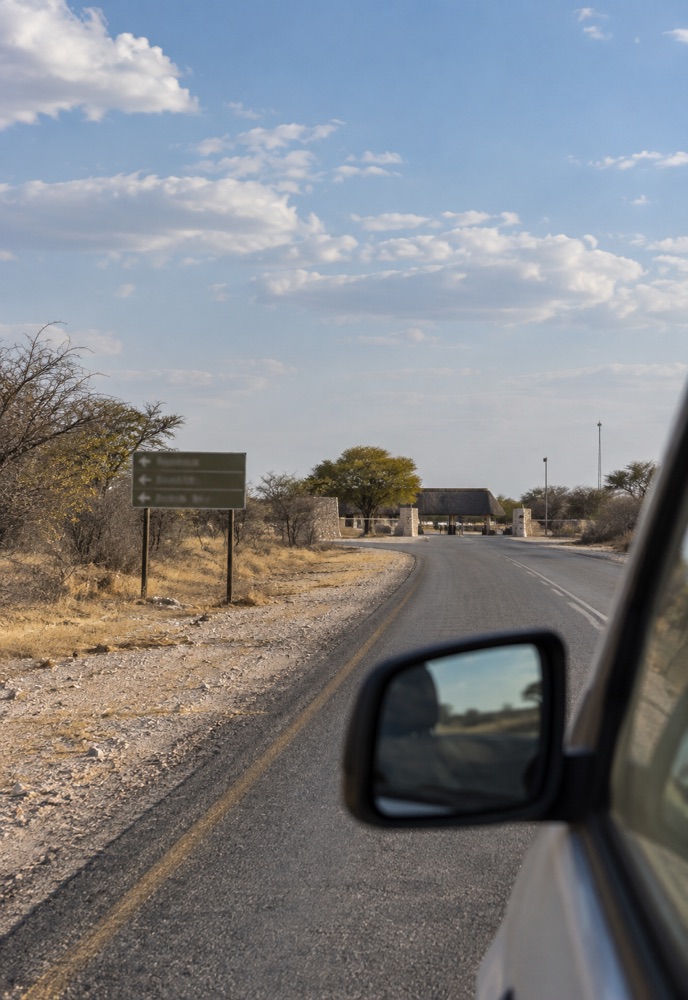
PLAN THE ARRIVAL BEFORE THE DRIVE
Start with the gate, not simply the park
Etosha covers a large area, and its entrances serve very different travel corridors. The best route is the one that delivers you to the correct side of the park with a comfortable margin before access closes.
01
Choose the entrance first
Identify the camp or lodge for your first night, then choose the gate that serves that part of Etosha. Searching only for “Etosha National Park” can send navigation apps toward an inconvenient entrance.
02
Treat the transfer as a full travel day
Fuel stops, meals, roadworks, animals, gravel and photography breaks all add time. A route that appears possible without stops may be uncomfortable in practice.
03
Protect your daylight margin
Aim to reach the entrance early enough to complete formalities and continue safely to the first overnight stop. Late arrival creates pressure precisely when slower, calmer driving is most important.
04
Confirm what can change
Gate times, road access, fuel availability and temporary closures can change. Reconfirm the final approach and current operating information shortly before departure and again with your accommodation.
THE FOUR MAIN ENTRANCES
Which Etosha gate should you use?
Each entrance works best for a particular direction of travel and part of the park. Use this overview to narrow the choice, then confirm the exact approach on a current map and with the property where you will stay.
SOUTH
Andersson Gate
The principal southern entrance is the natural choice for travellers approaching through Outjo and for a first night in or around Okaukuejo. It is commonly used from Windhoek, central Namibia and many southern itineraries.
EAST
Von Lindequist Gate
The eastern entrance serves the Namutoni side of Etosha and is usually the clearest fit when approaching through Tsumeb or from Namibia’s northeast. It works well when the first night is near Namutoni or the eastern boundary.
WEST
Galton Gate
The western entrance can fit itineraries arriving from western Etosha, Damaraland or the Kunene region. Access arrangements and the most suitable overnight options should be checked carefully because the west is more remote than the main southern and eastern approaches.
NORTH
King Nehale Lya Mpingana Gate
The northern entrance near the Andoni area can suit travellers arriving from north-central Namibia. It may substantially improve an itinerary when the route and accommodation are designed around the northern side rather than forcing a long detour.
GATE STRATEGY
The closest gate is not always the best gate
A shorter approach can be cancelled out by a long drive across the park to reach the first camp. Compare the entire door-to-door journey: starting point, entrance, formalities, internal park road and final accommodation.
APPROACHING FROM NAMIBIA’S MAIN TRAVEL CORRIDORS
Plan the route around where the day begins
These route profiles are planning frameworks rather than turn-by-turn directions. Roadworks, weather and access can alter the best final approach, so confirm the last leg with a current map and local advice.
FROM CENTRAL NAMIBIA
Windhoek and the central plateau
The usual northbound journey follows the main road through Namibia’s central towns before dividing toward Outjo for Andersson Gate or toward Tsumeb for Von Lindequist Gate. Treat it as a substantial transfer and leave Windhoek early rather than building the day around a final-minute gate arrival.
FROM THE COAST
Swakopmund and Walvis Bay
Several approaches are possible. Some favour a more direct western or northwestern route, while others use longer stretches of major paved road. Compare surface type, daylight, fuel range and your first accommodation instead of selecting the shortest line shown by an app.
FROM THE WEST
Damaraland and the Kunene region
Galton Gate or Andersson Gate may fit, depending on the previous night and where you are staying inside Etosha. Western routes can be remote, so begin with a full fuel margin, reliable offline navigation and a realistic understanding of the road surface.
FROM THE NORTHEAST
Rundu, Divundu and the northeast
The eastern side is generally the logical target, with the broader approach passing through the Grootfontein and Tsumeb area. Avoid combining an already long transfer with an unnecessary crossing toward the southern or western side.
FROM THE NORTH
North-central Namibia
King Nehale Lya Mpingana Gate can make sense when arriving from the north-central regions and when the first night supports that entrance. Von Lindequist may still be more practical for eastern accommodation, so compare the complete route rather than gate proximity alone.
FROM THE SOUTHWEST
Sossusvlei, Lüderitz and southern Namibia
These are major travel days, often better divided by an overnight stop. Trying to combine a long southern transfer, shopping, fuel and a park arrival can produce an exhausted driver and an unsafe final leg.
GATE AND FIRST-NIGHT PAIRING
Match the entrance to the first night
The first booking determines whether the arrival feels simple or rushed. Keep the first night on the same side as the entrance whenever possible, especially after a long transfer.
SOUTHERN ARRIVAL
Andersson Gate and the Okaukuejo area
This is the straightforward pairing for travellers approaching through Outjo. It avoids entering in the south and immediately committing to a long internal transfer across the park.
EASTERN ARRIVAL
Von Lindequist Gate and the Namutoni area
Use this pairing when the approach comes through Tsumeb or the northeast. The eastern side provides a sensible starting point before moving gradually through central Etosha.
WESTERN ARRIVAL
Galton Gate and western Etosha
Plan this as a specific western itinerary rather than an improvised shortcut. Confirm that the chosen accommodation, vehicle conditions and access arrangements fit the intended entry.
NORTHERN ARRIVAL
King Nehale Gate and the Andoni side
This can work especially well for north-central arrivals. Ensure the onward drive and overnight plan genuinely suit the northern entrance rather than assuming it connects quickly to every part of Etosha.
A BETTER FIRST DAY
Consider sleeping outside the gate before entering
When the transfer is long or unpredictable, an overnight stay near the appropriate entrance can remove pressure. You can refuel, organise supplies and enter the next morning with a full safari day ahead.
A CALMER ARRIVAL DAY
Build the final travel day in the right order
A reliable arrival plan works backward from the gate and first-night destination. It protects time for the tasks that navigation estimates do not include.
01
Confirm the night before
Check the selected gate, current access information, road condition, fuel plan and the route to the exact accommodation—not merely to the park boundary.
02
Depart with spare time
Leave earlier than the navigation estimate suggests. Breakfast delays, shopping, roadworks and slower traffic are easier to absorb at the beginning than near closing time.
03
Complete errands before the gate
Refuel, buy drinking water, make essential calls and download anything needed before the final approach. Do not assume every service will be available at the last possible stop.
04
Allow time at the entrance
Permits, payments, questions and queues take time. Keep passports, booking details and vehicle information accessible instead of buried under luggage.
05
Treat the internal drive as part of the journey
Entering the park does not mean the transfer is finished. Roads are slower, wildlife can delay progress and the camp may still be some distance away. Preserve a margin after the gate.
PLANNING PRINCIPLE
A navigation ETA is not an arrival plan
An estimated driving time normally excludes meaningful stops, entrance procedures and the slower road inside the park. Use it as one input, then add deliberate buffers for the real journey.
ROAD, FUEL AND NAVIGATION PREPARATION
Prepare for the approach, not just the park roads
The main approaches are manageable for ordinary travellers, but Namibia rewards preparation. Conditions become more important on remote western and northern routes and whenever weather has affected gravel roads.
FUEL
Begin with a comfortable range
Fill early and top up when a sensible opportunity appears. Do not calculate the day around reaching a particular pump with almost nothing remaining.
MAPS
Carry offline navigation
Download the route and keep a current park map. Confirm the gate name in the destination rather than relying on a broad pin for Etosha National Park.
VEHICLE
Check the spare and tools
Inspect the tyres, spare wheel, jack and wheel key. Know the rental company’s procedures and emergency contact details before coverage becomes unreliable.
GRAVEL
Adapt to the actual surface
Some itineraries include long gravel sections. Reduce speed for corrugations, loose stones, dust, animals and limited visibility. Do not let a delayed schedule pressure you into driving faster.
SUPPLIES
Carry water and food
Take enough drinking water and simple food for a longer day than planned. Heat, road delays and a breakdown turn a minor omission into a significant problem.
CONTACTS
Save essential details offline
Keep accommodation, park and rental-assistance contacts with the booking confirmation. Share the broad route with someone when travelling through quieter areas.
RENTAL VEHICLE CHECK
Read the agreement before choosing a remote route
Confirm permitted road types, tyre cover, roadside assistance and any geographic restrictions. The route must suit both the vehicle and the rental conditions, not only the traveller’s ambition.
ROUTE-PLANNING ERRORS TO AVOID
The mistakes that make Etosha feel farther away
Most difficult arrivals begin with a planning error rather than a genuinely difficult road. Correct these assumptions before departure and the journey becomes much more predictable.
01
Using a generic Etosha destination
A broad park pin may route you toward the wrong entrance. Enter the full gate name or the first accommodation, then inspect the final approach before accepting the route.
02
Choosing solely by kilometres
A shorter line may involve slower gravel, remote services or an inconvenient park crossing. Compare time, surface, fuel and arrival gate together.
03
Saving all errands for the transfer day
Shopping, fuel, cash and telephone calls can consume the margin needed later. Complete what you can the afternoon before and keep the final stop focused.
04
Planning a cross-park arrival
Entering at one side and sleeping far across Etosha turns the first safari into a deadline. Pair the gate and first night, then relocate through the park on a later day.
05
Treating closing time as the target
Closing time is a boundary, not a recommended arrival appointment. A useful plan reaches the gate comfortably earlier and still allows for the internal drive.
06
Trusting old route advice without checking
Roads, fuel, access and operating arrangements change. Use older accounts for context, then confirm current conditions through authoritative local sources before travelling.
DIRECTIONS TO ETOSHA FAQ
Quick answers for planning the journey
Use these answers to shape the itinerary, then reconfirm time-sensitive access, gate and road information shortly before travel.
Which Etosha gate is best from Windhoek?
Andersson Gate is usually the natural choice when the first night is around Okaukuejo and the route approaches through Outjo. Von Lindequist Gate can be the better choice for Namutoni or the eastern side, even though the wider approach continues farther north and east.
Which gate should I use from Swakopmund?
It depends on the selected coastal route and first accommodation. Andersson Gate is common for a southern arrival, while Galton Gate may fit a deliberately planned western itinerary. Compare road surface, fuel and access before deciding.
Do I need a 4x4 to reach Etosha?
A conventional vehicle is commonly suitable for the main approaches in ordinary conditions. A higher-clearance vehicle can improve comfort on gravel. Remote routes, seasonal weather and rental restrictions should be checked individually.
Can visitors enter through any Etosha gate?
Use only an entrance open to visitors and appropriate for the intended route. Access arrangements and temporary restrictions can change, especially on quieter approaches, so confirm before relying on a specific gate.
How early should I reach the gate?
Arrive with enough time for entrance formalities and the onward drive to the first overnight stop without rushing. The appropriate margin depends on the gate, camp, road and season; a final-minute arrival is never a good planning target.
Are the roads to Etosha tarred?
Major intercity approaches use substantial paved sections, but the complete journey may include gravel or variable surfaces depending on the chosen gate and preceding destination. Check the entire route, not only its main highway.
Can I enter at one gate and cross Etosha on the same day?
Some combinations may be geographically possible, but they are poor arrival-day planning when the transfer is already long. Internal roads are slow and wildlife stops are unpredictable. Stay near the arrival side first whenever possible.
What should I do if I am running late?
Shorten stops and contact the accommodation or relevant park authority for guidance. Do not try to recover time by speeding. If entry is no longer realistic, use a safe overnight alternative outside the gate and continue the next day.
FINAL ROUTE CHECK
The two-minute Etosha arrival checklist
Complete this check before leaving the final town or reliable service point. It catches the route errors that are hardest to solve near the park.
Correct gate
The gate name matches the first-night accommodation and appears correctly in offline navigation.
Current access information
Today’s operating information, temporary restrictions and the expected arrival procedure have been checked.
Fuel margin
The tank comfortably covers the final approach, possible detours and the next sensible refuelling opportunity.
Onward distance
The drive from the entrance to the first camp or lodge is included in the schedule.
Documents ready
Booking confirmations, identification, vehicle details and useful contact numbers are easy to reach.
Water and food
Everyone has adequate drinking water and simple food if the journey takes longer than planned.
Vehicle essentials
Tyres, spare wheel, tools and rental-assistance procedure have been checked.
Turnaround decision
There is a safe alternative outside the gate if delays make the original arrival unrealistic.
CHOOSE THE GATE, THEN BUILD THE SAFARI
Ready to turn the route into a complete Etosha itinerary?
Select accommodation that fits the correct entrance, use the map to connect the route and leave enough time for an unhurried arrival. If the gate, first night and wider Namibia itinerary do not fit comfortably, ask for help before confirming the booking.